Industry 4.0 tool kit

Always have enough time for a coffee

Great to celebrate the final acceptance of this customer’s toolkit. Designed to provide detailed OEE measurement and reporting, the kit uses its own wifi, edge computer, IoT devices, configured software and android apps to ensure the client gets a quick win and time to focus on capturing value.

While access to Industry 4.0 solutions is rapidly improving with reduced hardware costs and greater choice of hubs, the barriers from configuration and setup are still very real and lead to otherwise competent teams failing to start or becoming frustrated.

The open source code and examples will allow the prototyping team to go about extending or integrating the system in due course.

Industry 4.0 prototyping, 16 Machine Learning.

Machine Learning (ML) is advanced for prototyping but not impossible thanks to even more ML tools being released.

A graphical representation of the neural network architecture. It contains a scaling layer, a neural network and a probabilistic layer. The resulting model uses the two inputs to classify the label as true or false.

Good advice and planning will ensure adequate data-sets and models to reduce iterations, costs and disappointment, try Consilium Technology or other industry experts.

There are good resources for self learning as well, Google has tools and courses, link, Neural Designer can assist with model development, link.

In this example the prototype team has the objective to classify if a simulated part is correctly located in a simulated jig. A solution using ML would reduce complexity and improve roll-out compared to using trigonometric maths.

The team will use a smart vision sensor and program to

  • collect known OK/NOK data,
  • build and train a model with the data
  • deploy the model back to the smart vision sensor
  • test the model using the sensor

The model complexity increases from a single dimension to the more complex models required to allow for variation in camera and jig relative positioning in x,y and z rotation. The model will be developed using Neural Designer, link.

The team can extend the example to classify multiple parts.

This resource link contains the guide, accessories and IoT device programs to assist the team to develop and modify ML models and vision system applications.

Men have always detested women’s gossip because they suspect the truth: their measurements are being taken and compared :-Erica Jong

Industry 4.0 prototyping, 15 machine vision

The example introduces the prototype team to AprilTag’s to track the identity and 3D orientation of the tags relative to the camera, a worthwhile entry point to machine vision.

AprilTag is a visual fiducial system, …. the AprilTag detection software computes the precise 3D position, orientation, and identity of the tags relative to the camera”.

Created by Ed Olsen, link, the tag has less data than a QR code enabling it to be scanned for ID and orientation at further distances and in poor light.

University of Michigan demonstration, link

Jig fixtures Poka-yoke systems can include cameras for each part location to confirm identity and orientation in real time, creating objective evidence of quality checks for documentation requirements.

The recommended sensor uses a ARM Cortex M7 processor capable of scanning at 20+ frames per second and is able to be programmed in micro python, enabling full integration with other Industry 4.0 projects using MQTT messaging to send and receive data.

The resources link provides resources to undertake this task.

Industry 4.0 prototyping, 14 location demonstrator

Having key stakeholders participate in demonstrations, seeking their questions and suggestions is important. The prototype team will create a location demonstration kit to measure location proximity in two rooms, representing two levels of a facility.

  • Key requirements
  • demonstrate a facility that has one room in both level, detect movement in the room and between the two levels.
  • able to be deployed in 15 min at a location.
  • kit to consist of portable edge computer, portable local WiFi, active tags(4+), passive position nodes 8, 4 per room.
  • tags to report signal strength of nodes to edge computer via secure web
  • edge computer to determine proximity of tag relative to nodes
  • edge computer to provide secure visualisation of location and tags
  • stakeholders to view visualisation securely over web on their own device
  • quick configuration of nodes location in visualisation for changes
  • visualisation to display tag proximity to nodes as immediate/near/far using colour/opacity at a moving location pin

The resources link provides resources to undertake this task.

They muddy the water to make it seem deep : Friedrich Nietzche

Industry 4.0 prototyping, location

Location data makes an important contribution to the value captured in Industry 4.0 solutions. The location data enables visualisations and functions that are not otherwise possible. Let’s discuss the

  1. basics of how location methods work.
  2. the accuracy/resolution and repeatability/reproducibility of methods.
  3. the classification of location methods.
  1. HOW: The location methods use radio waves to
  • measure the strength (RSSI) of one or more signals, if the signal strength decreases with distance then the proximity of the device can be determined.
  • measure the strength of multiple signals and then use trigonometry to determine the location.
  • measure the presence and strength of one or more signals, if a “fingerprint” database of signals has previously been created then the location is known.
  • time to arrival/time to destination/round trip time (toa/tod/rtt) of one or more signals, If speed of the signal is known and synchronised then trigonometry can determine the location.
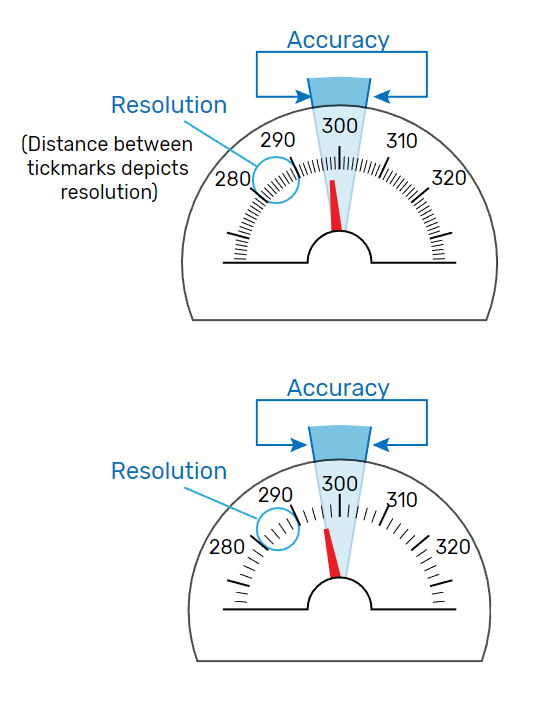
Accuracy vs Resolution, link

2. ACCURACY: The accuracy and resolution of the measurement is important and should be investigated at the desktop and in the field before investment as many accuracy claims are without basis in practice.

Undertake a Measurement System Analysis with study as part of the project to ensure the repeatability and reproducibility of the measurement is understood and valued.

Some location methods have resolution of +-100mm but are only accurate to +- 5m, there is no point in paying for this resolution.

3. CLASSIFICATION: Given the accuracy of a location method, a classification can be used to summarise the accuracy to be expected.

  • Presence/Zone (Yes/No)
  • Proximity (Immediate, Near or Far).
  • Location as distance (1D), point (2D) or a point (3D)
Location accuracy vs technology, link
  • Presence/Proximity systems: RFID, Bluetooth and WiFi tags/devices will preform well, check for the chip-set being used, (Monza 4, ESP8266, ESP32)
  • Location systems: Ultra Wide Bandwidth (UWB), RTT devices and Location certified Wi-Fi tags/devices will perform well check for the chip-set being used, (DMW1000/Android 9, IEEE 802.11mc enabled Wi-Fi Access Points)
I have learned silence from the talkative, toleration from the intolerant, and kindness from the unkind; yet strange, I am ungrateful to these teachers: Kahlil Gibran

Industry 4.0 prototyping, Interoperability.

Interoperability is the flawless exchange and use of data between disparate parties and is important because of the value it creates. McKinsey estimates interoperability contributes more than 40% of the expected economic impact of IoT. Meaning interoperability will both facilitate the project and generate the value that is captured.

Interoperability can be described as having 4 components

  • Foundation: the strategic inter-connectivity requirements of the systems.
  • Structural: the technical data exchange format.
  • Semantic: shared understanding of the data.
  • Organisational: shared respect of the data enabling its use.

The prototyping team can use the lead time and lessons learnt from their project to contribute to the Foundation, Structural, Semantic and Organisational Interoperability components such as

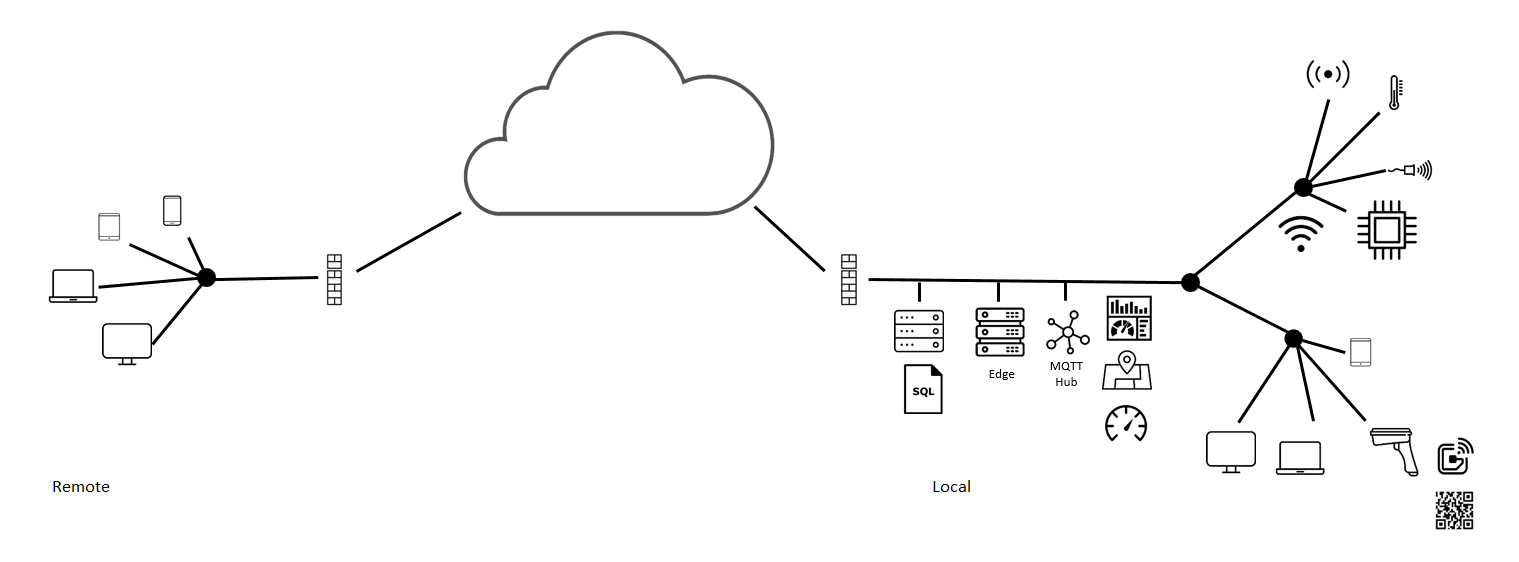
  • Foundation: infrastructure diagrams specify the device, edge and cloud resources and likely communication requirements.
  • Structural: flows, tables and functions indicate the data structure, classes and models likely to be used to contain and transport the data.
  • Semantic: user stories, visualisations and lessons learned engage stakeholders and improve common understanding of objectives and limitations.
  • Organisational: the consultation with and inclusion of stakeholders requirements, respect of data and its security and the sharing of value all contribute to trust and willingness of the silos to approve the exchange and use of data.

Reference Architecture Model Industry 4.0 , link

Advanced prototyping teams can use tools, formats and frameworks to contribute to Semantic Interoperability, link.

  • capture the knowledge
  • test the knowledge
  • extract the knowledge

Using enterprise architecture tools with industry specific plugins ensures the knowledge is captured in a framework to promote accuracy, completeness and to enable future extraction.

Other tools use this knowledge to create an Ontology in a format for use in reasoning tools. The reasoning tools apply the Ontology to test data to derive new implicit facts. These facts will validate or expose the accuracy and completeness of the knowledge, giving some level of assurance that current and future stakeholders will be able to use the knowledge for their understanding and use of the data.

Successfully demonstrating these tools during prototyping will promote their use in the more complex production project phase.

Industry 4.0 prototyping, 13 Position Chart Visualisation..

A position chart extends the visualisation tool set beyond graphs and gauges. The prototype team will make a Position Chart tool using HTML tools.

The resources link provides resources for the team to create a HTML node with functionality to display dynamic icons to show the status or the facility visually with colour, position and pop up information.

The team can extend the example to use MQTT messages to create dynamic icons to integrate the OEE status of the process/service.


Out of suffering have emerged the strongest souls; the most massive characters are seared with scars :  Kahlil Gibran

Industry 4.0 prototyping, 12 OEE.

Using Industry 4 solutions to provide OEE capability for manufacturing, logistic or service industries is logical step for the prototyping team. The project will develop their critical thinking ability and resourcefulness.

The OEE dashboard output displays the Availability, Quality and Rate metrics and the overall OEE result.

The solution builds on previous examples using Android and Pycom devices to interface to the real world, secure MQTT messaging, SQL storage, Node Red functions for dashboards and Operator Twitter for event logging.

A history summary provides immediate feedback to the operators for recent cycles, Ideal time is factored by expected OEE Rate to provide an OK cycle time which provides a visualisation of performance as Green or Yellow.

The solution provides SQL tables for work centres, parts, routing, and event logging.

An operator dashboard is provided to configure the work centre, the part and to display summary and current information

The resources link provides the Pycom device project, the SQL table configurations and the Node Red Flows that produce the functions and the dashboards.

The team should develop the solution by interfacing to the audio example to enable notifications for Availability and Quality issues.

We are all like the bright moon, we still have our darker side : Khalil Gibran

Industry 4.0 prototyping, Solution Design Methodology

The solution design process evaluates key inputs and balances the cost, capability, capacity and risk of potential technologies and configurations. The key inputs are

  • Value stream maps, Current and Future states.
  • Security, what drives the approach to security.
  • Industry 4.o budgets, initial and longer term expenditure.
  • Value capture, where is value expected to come from .
  • The need for short term wins and attitude towards risk.
  • The readiness index of the client and providers.
  • This resource link has a methodology for the evaluating the inputs alongside the lean engineering principles that I use when proposing an Industry 4.0 solution

This resource link has a methodology for the evaluating the inputs alongside the lean engineering principles that I use when proposing an Industry 4.0 solution

The methodology seeks to reduce the complexity of determining

  • what capability/technology to include or exclude,
  • what level of implementation is required/possible
  • how to manage the various project risks.
I am not interested in competing with anyone, I hope we all make it :- Erica Cook

Industry 4.0 prototyping, 11 IoT device

The team will use an IoT device to deliver messages to the edge computer for use in a visualisation. Secure MQTT messages carry the location, the temperature and orientation of the IoT device from outside the local network to arrive securely at the internal edge computer.

The resources at this link will assist the team to

  • Configure the ATOM development environment to program the device.
  • Configure an FTP utility to transfer the security certificates to the device.
  • Test the secure MQTT configuration.
  • Upload and review the provided examples to the device.
  • Configure the Node Red visualisations.

Men have always detested women’s gossip because they suspect the truth: their measurements are being taken and compared :-Erica Jong